The Joys of Presence

Recently, during a bit of a spiritual and energetic dip, I picked up a book off my shelf — Eckhart Tolle’s The Power of Now. Tolle is pretty well known because Oprah Winfrey picked him up a number of years back. She hosted numerous podcast discussions with him and eventually helped produce a whole podcast series with him, talking about the teachings from his book A New Earth. He’s a good spiritual teacher, blending all sorts of spiritual traditions into something that is just sort of him.

But I digress. The Power of Now is essentially a book about the importance of presence. At the time that I picked it up I really needed the strong reminder and hand-holding of that teaching. I was spending a lot of time mulling… even ruminating. Ruminating is never a good look, and I felt pretty dismayed about the runaway freight train of my thinking. So… I dove into the book, and it was enough to get me out of the ruts and back into a place where I could at least occasionally drop into something like presence. And get out of the cycle.

That was a couple of months ago. Then more recently I opened up an email I subscribe to, and found a reference to a tool — technically an app, though I hate to limit it with the use of that shallow word. The tool is Henry Shukman’s The Way. Poet and Zen master, Shukman has put together this most remarkable teaching platform. I’ve dipped in and out of meditation in the last decade and a half, sometimes more vigorously than others. But this new thing in my pocket is the most remarkable teacher. Shukman’s voice, his teachings, his calling to presence… they’ve hit me like a revelation in this moment of my life.

I’ve been managing a morning sit for the first time in years. And wrapping my head around certain ideas in the practice that have eluded me for years. Nothing dramatic. Just simple concepts, but that have somehow been so extraordinarily complex.

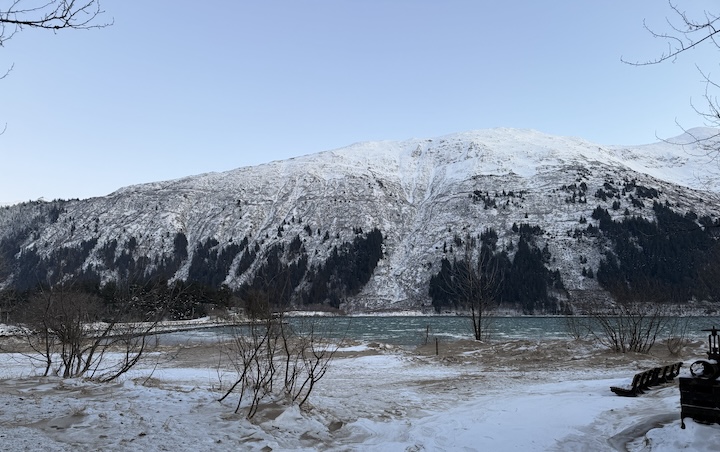
This morning on my walk — 6 degrees Fahrenheit, wind whipping, cold snow squeaking and crunching — I was able to look around and feel it all, and feel grateful for it all. Grab, just for a moment, some presence. And really to delight in that. (Shukman’s Snowy Morning is a nice pause on a similar feeling… though his is about mortality. I suppose it’s all about mortality, really.)

I love that when life challenges you, it oftentimes also offers you the gifts you need to move through it. It’s a truth that tells itself again and again. May it always be so.

The Profound Sleep of Safe Children

There are one hundred times in any day when I look at my child and feel an overwhelming, heart-exploding love. This feeling, familiar to so many fortunate parents, can feel so acute, like a parachute drop, like an eruption of light from the sudden birth of a star. Big stuff. From such small things. A crooked smile or his delight at some word play while driving in the car.

Few things compare, though, to looking at him when he is asleep, with his arms curled around Foxy and Baby Nothing. Those moments when I whisper to him that he is loved, by me and by his father, and when he does not stir, because he is so far into the land of sleep of safe children. I have such profound, soul-squeezing love in those moments that I could drop to my knees and weep.

His safety is a privilege. I know that every day, and I feel gratitude for it every day. It is a luck of birth, of geography, of race, of gender, of choices made by my parents and grandparents and all my forebears, of my own choices, of our moment in history, the timing of my arrival in this world, and his. It is a function of living in a place where water falls from the sky in abundance. It is fortune. Which, for those of us not buffered by unimaginable wealth, is ephemeral.

Like any mother, I want to fight for a future of riches for him — riches in friendships, family, kindness and grace. Riches in knowledge and insight, and in compassion. Also in food. Also in peace.

I’ve never been a good student of history, nor truthfully of politics. I’ve believed myself to be part of the masses rather than an agent of impact. (Ironic, for someone who helped build a public library.) But I think that the privileges conferred on me in my own life demand more of me than what I’ve given in recent years. I’m not one for grand pronouncements and resolutions that I can’t follow through on. But I do want to start by assuming the posture of student, and studying. To that end, I’m building my book list, and will embark. Reading may not ensure safe sleep for all the future nights of my son’s life. But it is also likely one of the most powerful tools I currently have.

A Wing and an (Answered) Prayer

This morning I left Kodiak after a quick 6-day visit. The longer I’m gone from my old home, the fewer people I feel the urge to see when I’m there. My time on the island increasingly simplifies. I arrive, I wander around the family home. My little explodes with joy at the time with his cousin. I drink too many ciders.

This trip was made beautiful by the presence of BW. There was new magic in showing him the things of my past. There was also new magic in shaping the contours of a shared future. I was deeply moved to see him building a relationship with A, and to see A take his hand on the beach — a simple reflex that carries so much more meaning and potential to the adults who receive it.

We are taking off now, on our way east. More family and more love ahead.

Renewal and Rest

renovation (n.)

c. 1400, renovacyoun, in theology, “spiritual rebirth wrought by the Holy Spirit,” also in a general sense, “rebuilding, reconstruction; a making new after decay, destruction, or impairment,” from Old French renovacion (13c.) and directly from Latin renovationem (nominative renovatio) “a renewing, renewal; a rest,” noun of action from past-participle stem of renovare “renew, restore,” from re- “again” + novare “make new,” from novus “new” 

https://www.etymonline.com/word/renovation

In recent morning walks with my friend K., I’ve been insisting that I no longer believe in fate. I’ve been sharing this as a counterpoint to how I feel I made some of the earlier and most defining choices in my life. Loves chosen because I believed they were “meant to be.” Course-setting academic paths selected because of some sense that things “happen for a reason.” As a verbal processor, I think I’ve been trying on an idea in these conversations — one in which I reject the mistakes I’ve made in life that have yielded the things that feel like sorrows. Perhaps I am sounding the edges of my grief. Perhaps I’m working to explain and categorize the errors of my past, so as to inoculate myself against them for the future. Perhaps I’m struggling with my sense of the passivity with which I charted my life path, or with which I allowed it to be charted for me.

So the rejection of one way of thinking about things — the firm palm in the face of “fate” — has felt like a a bit of summoning, or spell-casting. A way to assure myself and those around me that I can be trusted with my own future. I’m no longer a fool. Henceforth I live with agency. I’ll not be tricked by palliatives like “meaning.” Fool me once, shame on you; fool me twice, shame on me.

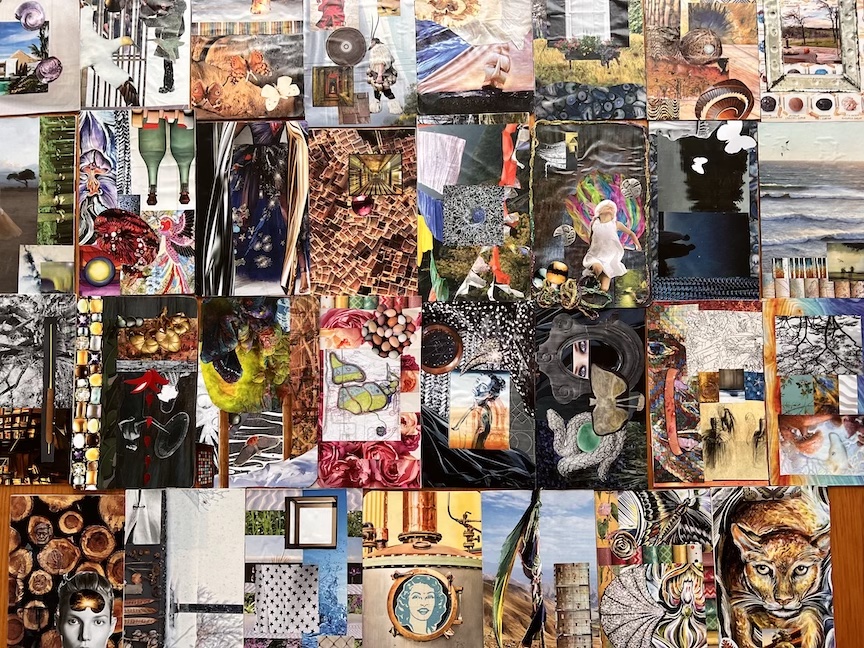
This morning, though, I am seeing it quite differently. From my vantage point here on my tiny couch — a vantage point that includes my and A.’s new fish tank, the piano I recently purchased at Costco, my music for the Bach Cantatas I am singing with a choir this Christmas season, a mound of defrocked couch cushions whose covers are in the wash, and most importantly the collage cards that have been a method of creative outlet for a decade — I am realizing that I still firmly believe in fate. But that my belief in fate is one that stems from a sense of agency in creating it, rather than passivity in receiving it.

One of the greatest, not-so-secret joys of my last year or two has been my cheerful embrace of that time of life called “middle aged.” I am so profoundly happy to be here. I am so pleased with the insight and calm that comes with it. The sense that I can recognize the cues and the patterns, and know what to make of them. The insight that comes the familiarity of having walked a path before. For example, I know that when I open a book of music and begin to read from it, parts of my brain light on fire and summon ways of thinking and interacting with the world around me that are both fresh and ancient. I recognize that when I sit with scissor and cut and arrange and glue, I open a channel through which dormant feelings and ideas can begin to move again. I may not always make time for these things, but I know that when I do, certain things will happen as a result. I’ve seen the proof before. I’ve learned this.

One thing I have certainly learned in my life is that active space-making — imagining, describing, allowing — brings things into my life that have not previously existed but that are needed. It’s untenable to ascribe meaning to all things that happen in life. But the arrival of the pianos at Costco at the moment I had a deep need for one? The stack of free magazines at the Amazing Bookstore that were absolutely perfect for the collaging that needed doing? The landscape-brightening snowfall on the very darkest day? The king-size mattress that needed rehoming at the moment of my need? Well — these things aren’t fate. But they do feel like a caretaking from the universe at a time when care is needed. And I’ll accept them all with gratitude.

The word “renovation” is in my head as I move about my house today, like the aurora unfurling across the unfathomable night sky. I love that the Latin for it, renovationem, includes both renewal and rest. I’m in an active stage of renewal. Renewal, plus reclamation, reestablishment, reimagining, rethinking. I’m also in a realm of receiving. The things I’m receiving most in recent months are the kindness, generosity, and unflagging patience of friends (and family). I’m excavating and unearthing. I’m also creating. I’m imagining. I’m noticing. And I’m resting. And the act of resting allows the other things to come into being. I am grateful for it all. Endlessly so.

p.s. Don’t miss the performances of the Juneau Bach Society on December 2nd (8pm) and December 3rd (3pm) at K̠unéix̠ Hídi Northern Light Church!

J.S.Bach: “Wie schön leuchtet der Morgenstern” BWV 1 (1725) for the Feast of Annunciation of Mary (March,25) Netherlands Bach Collegium, Pieter Jan Leusink

Trepidation

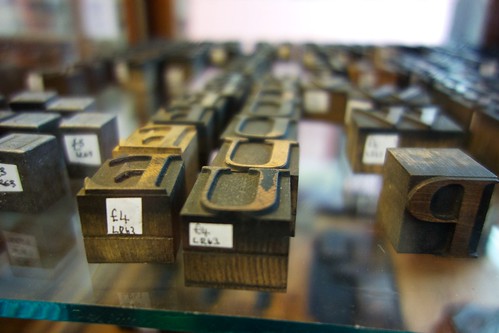
Featured image — “Typeset” by Paul Hudson — licensed under CC-BY 2.0

These are my first words.

There. I’ve made them. That’s a relief.

I’ve hardly written in years. There has been no big block, no reason one way or the other. But COVID happened, and shortly thereafter my return to work after more than two years spent primarily mothering. And somehow the combination of the return to work and parenting my child combined in a way that kept me from writing. So after years of being a writer, I suddenly found that I wasn’t.

Some months ago, shortly after my dad died, a man I know who’d also recently lost a parent suggested that I might turn to words to process my grief. Honestly, it hadn’t occurred to me. And the fact that I hadn’t occurred to me drew me up short. There were years and years of my life during which reaching for words were my primary way of processing things. How was it that this had not crossed my mind?

For the last several months I’ve been sitting with this question — with the feeling of being a not-writer. But it seems the easiest way to begin to remedy could simply be to begin to write.

So here we are. First words written.

How the Eye Translates to the Mind

From the corner of my couch, the view out the picture window is a perfect artist’s study. The window gives view onto a giant mountain, two lovely trees at two different distances from my house. A beautiful full bush in the near foreground. Foxgloves and ferns rising into the view in the near foreground. There is a footpath leading from my house away to the street at one angle, a road and sidewalk that intersects it at another angle. Across the street my neighbor’s picket fence adds a slim element of structured verticality. Phone and power lines dip across the center of the view. Our arctic entry, with its wide clapboard covering fills about one-quarter of the view, with a trellis for our clematis on its side, framing a window, with crisses and crosses like a Japanese arbor. And in the upper lefthand corner, a spray of a soft-spined pine dips across the triangle of sky not blocked by the mountain.

The composition is nearly perfect.

This evening I sat looking out this window and decided I wanted to attempt to sketch it. With so many points of intersection, bounded by the panes of the window, I felt I had enough guideposts to possibly render it on a page. It was a challenge in “seeing.” Could I make note of all the places where lines crossed and give it some feeling of truth?

In my mind’s eye, I held the image of Renaissance artist Artemisia Gentileschi from the amazing 1997 French film, standing before a framed grid beside her easel on a beach, learning to paint perspective. I tried in my imagination to impose that grid over the view I was seeing, to allow the lines to flow at the correct angles, and the point where mountain crossed roof line, and power line crossed ash tree, to fall on that grid.

Not surprisingly, it was all wrong from the very first strokes. I tried to understand the window frame first, then fill in from there. In my first attempt I drew in the lines for the panes, then the entryway with its hashed trellis, before realizing that the mountain, which takes nearly 50 percent of my view frame, had nowhere to fit. Next I tried Drawing just the vertical lines, then the points of intersection (roof crossing left hand edge of the center pane at the midpoint, mountain crossing the lefthand edge of the left pain at a similar point. But quickly I realized that the maple tree, which stands in front of nearly half of the mountain, was being squished into a tiny wedge.

I stopped there, with light and hours of the day fading. But I realized that many more experiments on this image would be possible. What if I started with the points of intersection, and no window frame, and built out from there? What if I threw aside the pencil and just made dashes of color with paint that approximated the portion of the image that each element takes up? And what if I used a grid, right here in front of my eyes, to learn the language of perspective?

This entire étude was inspired by the first pages of a paper called The Art and Science of Looking Up, which was recommended by a fellow member of a learning cohort of which I’m part.

It has been a pleasure to spend the last forty-five minutes looking up in this manner. Though I’ve ultimately pulled my computer onto my lap to describe what I see, rather than render it on paper, I’ve largely done so with my eyes out my window, watching the day slip into dusk and the clouds move across the precious gift of blue sky, granted to me on this lovely evening as a brief respite in weeks upon weeks of rain. I feel a calm that has eluded me for many days, and I give thanks for that. This, then, is perspective.

Image created with Prisma.

Put Pen to Paper

About million years ago I heard about a writing challenge. The idea of it was to write 50,000 words in the month of November. This, it was figured, was roughly the length of a draft novel. Pull it off in whatever way you could, and you’d have a draft to work with when December 1st rolled around.

My signup confirmation from the organization that runs the challenge arrived in my inbox in January of 2008. I The first-ever reference to it in my email is from nine days earlier, sent from my old work email account. It just has the URL for the organization, Nanowrimo, which is shorthand for Na(tional) No(vel) Wr(iting) Mo(nth).

I don’t recall how that November’s efforts went. I know I had quit my steady job earlier that year, in order to pursue writing. I had a book burning inside of me about the “rationalization” of the crab fisheries in the Bering Sea. My book was going to be about how “crab ratz” was a local expression of a much larger and slow-rolling catastrophe playing out across the United States, pushed by federal policies that used economic justifications to privatize giant resources held in common, and grinding the working people of the land and sea under their heel in the process. My hometown was being gutted by the policy, and I was on fire with desire to share the story with the world. My plan was to do contract consulting part time, and write in the other half of my day.

But I also know that by the time November rolled around I was deep into the most significant mental and emotional crisis I had (and still have) ever experienced. I’d parted ways with my longtime boyfriend that the summer, and it had kicked off an almighty crisis of being un-homed, uncoupled, unemployed, and totally lost. I think I recall that I only consumed grapefruit and listened to Bon Iver on repeat for most of a month, and I think that month might have been November. I do not think I wrote 50,000 words of a draft novel.

But, hey! There’s always do-overs! This past November, in a manner typical of my extreme tendencies, I took a hiatus from the rest of life and diligently banged out 50,000 words. Laundry, sleep, and harmonious domesticity be damned, I was going to get my words.

Well, almost. I actually had fragments from previous writing that I called in for cut-and-paste a few times, when crazy toddler bedtimes and exhaustion were going to keep me from my 1,667-word daily quota. But at the end of it, I had…. well… 50,000 words. Unfortunately, I had no book draft whatsoever. I was about 1/4 of the way into something, and it was changing shape all the time, and I had completely lost the thread on where it was going. I was exhausted and deflated, even with the goal having been met. I never opened the document again after the evening of November 30th.

A couple of weeks ago I remembered about it, though. And I thought, “Huh, interesting.” Because the draft is about a community of people in the time after a great catastrophe. This is no surprise, because I’m a fangirl for dystopian fiction. But I wondered if there might be anything in there that felt relevant to our current moment.

I’ve skimmed the writing a bit today. And I’m pleased to observe that, while it’s still a totally tangled smash of about three plots with nothing near an end or even a clear driving narrative, some of it actually doesn’t suck all that much! This feels like an accomplishment of no small significance.

The working title for my NaNoWriMo project.

I’ve been working through a worksheet on creativity in recent days, tasked with identifying my creative “domain” and medium. I won’t bother with all the why and what of that exercise, but there’s a question in there about creativity that is “that is ‘nice to have’ versus that which is essential for your well-being.” When I re-read what I’ve written in that worksheet, I notice how much I hedged when describing the importance of writing — even though the worksheet is for me and me alone to view. I’m not certain whether that is authentic, or self-protecting. At once point in there I’ve jotted down that the “wanting comes in waves, as they say.* I’m not sure this is something I need in order to feel fulfilled in life. By the same measure, though, it’s something that never goes away and is always nagging at the edges of my desire.” 

Looking back on it, I wonder where my uncertainty or ambivalence comes in. Even though I’ve never “become a writer,” I sure enjoy writing all the time. And I’ve done it for many, many years now!

And with that, another evening has been chewed up…. writing! Time to retire and hopefully do a bit of that other half of the equation. Reading!

Impatient Gardening

For as much gardening as I do, I’m pretty crap at it. I manage to grow lots of dark leafies every year, and typically some carrots. A few radishes in a brief window. Those are my reliables.

Then every year I’ll try something new, too. Last year we did squash, and they grew amazingly well in our climate change summer. Two years ago we had some great cabbage.

But I can never pull off all the things consistently. Meanwhile, my neighbors at the community garden have (already!) giant squash plants, giant beet plants, giant carrot fronds. Mine are all measly at best.

I could chalk it up to my distance from the garden and the work of getting out there regularly, but a woman in my neighborhood has a neighboring plot and her stuff is amazing.

I could chalk it up to the 3-year-old. That’s probably a pretty good bet for at least a portion of the failed potential. Also the summertime-absent partner.

But I know the real culprit. I am incredibly impatient! I also think I have a good dash of A.D.D. For example… this year I actually planned my beds. Planted in them. Then wrote what was planted in a book. But the book is somewhere I can’t put my finger on. And though it would likely take me all of 5 minutes to find it, instead I think I may have pulled out all my beets today thinking they were weeds.

Similarly, when it comes to watering, I can’t stomach standing around for the time it takes to give it all a good drenching. I bought a sprinkler this year, which has definitely upped my watering game. But I still get bored and can’t hang around for the time it really needs.

Yes, in fairness to myself, the toddler. That’s a real thing. He’s a champ about going to the garden. But he can’t hack it for very long. So I’m always rushing and getting pulled away.

But I think that, in the long run, learning to slow down in the garden would be a great practice for life.

May 9, when everything was still brown and we were desperate for refuge from COVID.

The Cat

We got this cat back in April. His name is Phillip. He was our COVID foster. He is now our COVID adoption.

Phillip is a lynx point, which apparently is cat fancy for “Siamese mix.” The lady at the shelter told me this (about his Siamese-ness) when I spoke to her in a hurried fashion prior to bringing him home. What did not compute for me then is that Siamese mix means loud.

Phillip is like a dog. He wants to be where we are. Interestingly, he wants to be where Auggie is. This is despite the fact that Auggie has him trapped in a strangle hold for much of the day. Phillip also wants to be where I am. (And where Chris is, when Chris is home.)

When Phillip is not with us, he lets us know. There is a low “mrrrowwww” that escalates quickly to “rrrreoowwww” and then “yeaaaowwww.”

I have been on edge since he arrived.

As I write this he is sprawled across my lap in a warm, breathing, delicious blanket of cat. But can I revel in that? No. I’m on alert. Waiting for the moment when me might spring to life and go meow outside Auggie’s bedroom door.

This on-edge-ness is spot-lighted by Phillip and his presence in our life. But I’ve also started to see and understand since his arrival that it’s a feature of the basic construction of my own, particular nervous system and patterns of worry. Stressful though it has been, this process has been instructive. I’ve been able to see something that I previously couldn’t — my tendency to lean into the what-if sequence, and get worked up about it when nothing has or necessarily will happen.

This is in contrast to Chris, who is constantly encouraging me to lighten up. Which infuriates me and also inspires me.

Phillip is here to stay. The little guy is going to teach me things about letting go of control. I’m glad for him.

Day Zero?

I’m tired, and I should be turning my lights out. Two weeks ago I had incredible “sleep hygiene.” The same wakeup time every day, a very early bedtime, a solid commitment to 8 hours of sleep.

COVID-19 has upended all that. Sure, part of it is the unhealthy media diet. (Binge, binge, binge.) Some of it is trying to figure out how to do my job around the waking hours of my son. Some of it is the need to do more, more, more.

So I ought not be posting. But I feel I should. Because looking back in a few days or a week, it may turn out that this was Day 0 before everything went insane, and I want to memorialize it.

So here’s what happened in my life today, in no particular order:

  • Auggie and I snuggled in bed and hid under the covers together for 45 minutes
  • Chris showered and went to work
  • We made pancakes
  • I worked a bit while Auggie watched some PBS
  • We went to see 2 baby goats, 2 mama goats, 2 horses, a pony, and two donkeys
  • We stopped in work to get my plants and my computer plug before calling the office “closed”
  • We had a walk up by the governor’s mansion and down the staircase to Willoughby
  • We ate quesadillas with greens
  • Chris did more late-night Costco shopping for random things
  • I worked on my laptop
  • Auggie and Chris went for a run
  • I talked to my brother
  • I wrote an email to the borough and the school district asking them to close down school buildings to all people (read: teachers) and to start putting firmer restrictions on other workplaces
  • Auggie and I went for a walk at Lena Beach

I just wanted to write some of those things down because I think it’s possible I’ll look back soon and realize how simple life’s pleasures were today.