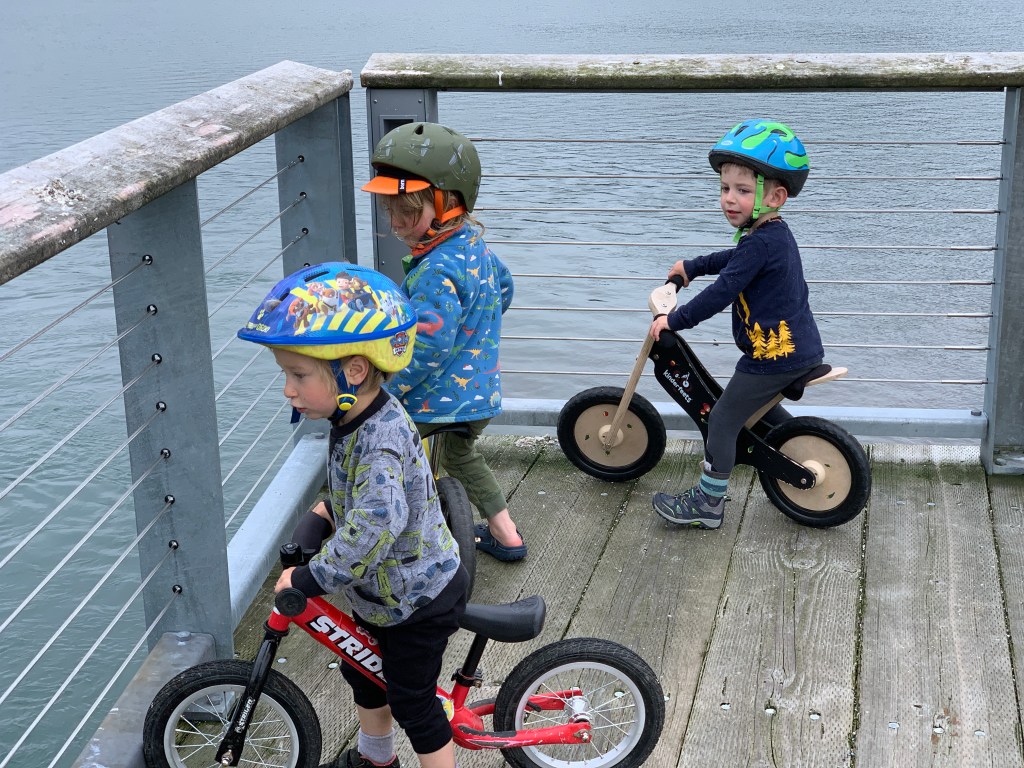
The boys rode bikes today. Letting this happen takes a tremendous effort in letting go. There are all of the “shoulds” and “shouldn’ts” that run in the head. And then there’s the simplicity of three 2- and 3-year olds learning to accelerate and careen. Learning that wind makes their hair blow when they go even faster. Learning what it feels like to be part of a pack. The contrast in experience for them utterly joyful, and so natural, even after all these months–these not-insignificant percentages of their lives–gone by. A delicious two hours of completely normal boyhood.
I could feel my body relaxing.
It’s such a relief to see the normalcy.
Their return, if fleeting, to normal takes place against the backdrop of Juneteenth. I will confess to be one of the white Americans who had no idea that Juneteenth existed. I’m glad to know of it now. In this complicated moment I’m glad for anything I can learn that can guide me to be of better service in the world. My view is so appallingly narrow. But I see and accept the privileged grounds on which I build my life and that of my son, and it’s not acceptable to do nothing, or the near-to-nothing I’ve been doing for all of my life up until now.
This interview between Krista Tippett and Resmaa Menakem laid down some solid guidance for a starting point.
… White people, don’t look for a black guru. Don’t look for an Indigenous guru. Find other white people, and start creating a container by which you can begin to work race specifically; not race in this and race in that and break bread together and do all that — not that; not a book club. You specifically deal with the embodiment of race and the energy that’s stored with that.
I have his book on order, and while I recognize that we can’t just solve this problem intellectually, I also know I have to start somewhere.
All of the overlapping confusions and pains and intensity of this moment conspire to undermine the beauty of today. But I also cannot let that be. My little one deserves the gift of joy in wheeled flight. And I, his mother, can be allowed to love that moment. To adore him unendingly, and weep when I hold him in my arms for the sheer magnificence of his little being. I also must recall in every moment the love that every mother has for every magnificent, perfect child. I must learn to do whatever I can to make sure the losses and griefs we experience are those of Life, and not those of an oppressing heel–or knee–stepping on our children’s necks.
I’m tired, and I should be turning my lights out. Two weeks ago I had incredible “sleep hygiene.” The same wakeup time every day, a very early bedtime, a solid commitment to 8 hours of sleep.
COVID-19 has upended all that. Sure, part of it is the unhealthy media diet. (Binge, binge, binge.) Some of it is trying to figure out how to do my job around the waking hours of my son. Some of it is the need to do more, more, more.
So I ought not be posting. But I feel I should. Because looking back in a few days or a week, it may turn out that this was Day 0 before everything went insane, and I want to memorialize it.
So here’s what happened in my life today, in no particular order:
Auggie and I snuggled in bed and hid under the covers together for 45 minutes
Chris showered and went to work
We made pancakes
I worked a bit while Auggie watched some PBS
We went to see 2 baby goats, 2 mama goats, 2 horses, a pony, and two donkeys
We stopped in work to get my plants and my computer plug before calling the office “closed”
We had a walk up by the governor’s mansion and down the staircase to Willoughby
We ate quesadillas with greens
Chris did more late-night Costco shopping for random things
I worked on my laptop
Auggie and Chris went for a run
I talked to my brother
I wrote an email to the borough and the school district asking them to close down school buildings to all people (read: teachers) and to start putting firmer restrictions on other workplaces
Auggie and I went for a walk at Lena Beach
I just wanted to write some of those things down because I think it’s possible I’ll look back soon and realize how simple life’s pleasures were today.
Ridiculous how hard everything is. No one is immune. Everywhere I look someone is suffering, angry, breaking up, dying. Including me. (Not the dying part… at least not imminently.)
Some people I know fixate all the time on the catastrophe of it all. Others find some sort of off-switch. Hide behind TV or exercise or some sort of activist organization. Me, I think we’re all fucked. And spend each day trying to make magic for my perfect boy while warding off the swooping bats (demons?) of my own despairing, black-and-white nature.
My memory is utter garbage. All the work of maintaining (composure, hope, face, focus, organization, control) wipes out every available space in my mind. So yesterday’s conversation (argument?) is un-recallable. The memory palace of my daily life still holds strong, though. Ask me where that sock is and I’ll know. (Tucked behind the book about bear cubs in spring. Pair in dryer.)
A family member is dying tonight. In this storm. Or maybe it won’t be tonight. Maybe they’ll hold until Tuesday. Or not. It doesn’t matter except it’s all the world. Bright thread of life.
It’s all so achingly hard. The illusion of bright tomorrows has been long annihilated. Maybe by other deaths. Maybe by divorces and car crashes and cancer and that fucking glacier, that shrinks and shrinks every day.
No matter. Life is and has always been suffering. The TV lies to us but our stomachs know the truth. Thank god we’re in good company. Every fellow traveler walks the same path with us.
It’s impossibly hard to sit on the edge of my son’s bed, delighting in the trilling word games that are the genius of his growing mind, his language acquisition, his exploding consciousness, and feel the hard stone of the climate crisis sitting in my stomach. We play together with lion’s roar, stinky toes. He mouths rhyming words silently as I repeat them to him again, again, again. He beams with pride. I sniff him, inhale him, brush lips on his temple and hair. I tell him I love him; that he is precious to me. “Precious boy,” he replies.
We all are mortal, each of us. So it has been since the dawn of our days, so it remains for we who stand here on the brink of this great unraveling. My love for my child is no less, no more (though of course infinitely, incomparably, unbearably more) than that of any, every mother who has come before or after me.
Still, the joyful worlds I weave for him, of lush forests and creatures of the jungles and savannas, feel like lies. When my mother read me stories in my youth, did she confront the same sense that they were untenable, unreachable? Did the simple, pastoral landscape of Frog and Toad feel achingly ancient, lost to her? She is gone; I cannot ask her. But I wonder.
The magic of my son is my gift and my burden. His coming hardship, his living in this too-hot world, is an agony for which I have bargained with the devil. “Please, allow me this child.”
I fear that my bargain was too selfish; that he will pay its rising price. Yet we laugh together with such true, pure, mystical glee. Please, God, let that joy be tender for the debt.
I labor determinedly in our garden, seeking to re(dis)cover lost knowledge and skills. Each seedling’s struggle through soil to light is a celebration. I want to save him. I want to save myself. I pray I cultivate in him this wonder, fleeting or hopefully durable. Wonder is the only thing for which I feel honest hoping in these days.
I have traded my life for his. Each parent, all parents, only lucky enough to do so. Have I also traded his life for mine? For this, the love that bursts inside of me? This thing, so sweet, so crippling, so precious, that he has gifted me.
Before my mother died the cancer in her abdomen became like a stone. A heavy rock setting inside her. Each morning in the last weeks of her life she and I would rest beside each other in the pre-dawn birdsong and she would love me, her only daughter. In the fleeting moments before her pain took over she would breathe me in, brush fingers on my temple. I would call her Mama.
We are mortal. We are doomed. But I will take my child out each day and live. I will cultivate. I will seed wonder, tend our garden with him alongside. I will eventually tell him we all will die, or he will discover it himself and, with luck, I will comfort him through its dark revelation. I will be sure he knows the gratitude I feel for his unwitting agreement to pay the debt of my love for him; of my bringing him into this unimaginable world. Forgive me, I will ask. I love you so much.
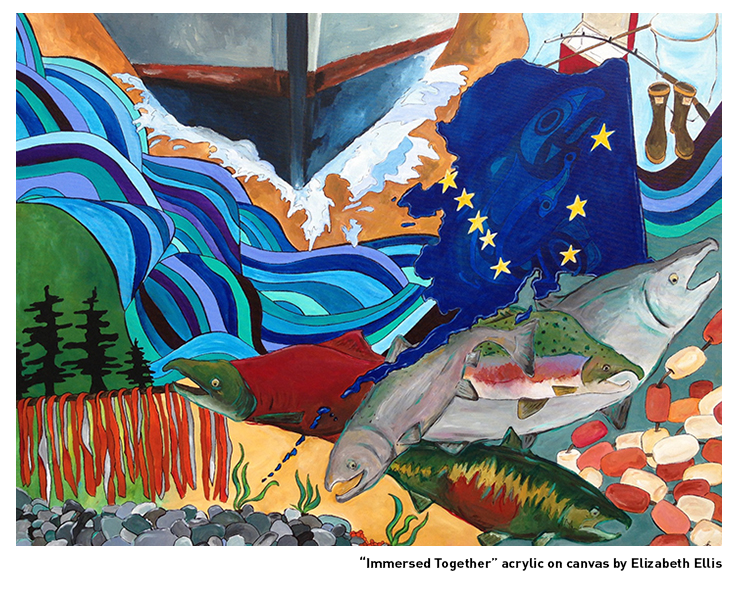
Salmon is our most bountiful wild food source, and we think of them as coming “home” when they return to the streams where we harvest them. But they are at home throughout their range—in the places where they live their seasons of adulthood as well as they gravel where they emerge or the splashing pools where they finally fall away. The challenge of loving the salmon who come home to the place where we wait for them is that we forget about all the parts of their lives that they spend away. They are at home in all those places and they live in all the places throughout their range. We often connect our desire to act—to protect them—to the place where they come “home.” But the home that they need is everywhere where they live.
Baby coho salmon, while still smaller than the size of a pinky finger, spread out over great ranges, sometimes transiting miles or even tens of miles in this juvenile stage. If we imagine them to need only those streams where they have spawned, we miss the enormous complexity of the watery lands that support them. Any Alaskan child who has walked, eyes down, through a forest or field, will have seen these tiny “minnows” flitting about in the shadow of creekside grass, or moving through the dappled light in the rivulet of a stream passing beneath a cottonwood tree. These are the homes of our salmon. These swampy places are no less important than the shallow streambed where we saw the parent generation spawn and die.
We grow frustrated when we attempt to take steps to safeguard our salmon, only to find that our actions in our backyards or in our boroughs or in our watershed don’t seem to be enough. We learn about and focus our efforts on stream bank restoration, for example, but we find that climate change is taking bites out of our fish faster than we can act to restore them. We temper our own harvest, taking only what we need so nothing remains in our freezer at year’s end; but we know that others downstream from us or out in the marine system are harvesting in numbers that surpass our own impact. The feeling of helplessness can be overwhelming. Our individual actions feels insignificant against the 1,000 cuts that strike at our fish.
The salmon is a microcosmic example of our entire global system. Everything in the world around us is spinning faster and faster; our impacts are spiraling out around us. Our desire to rein things in, or to find something sane in the whirl of the storm, feels more and more unattainable, even as we reach for it.
Our systems are so large, so all-encompassing. Words printed in books of law are meant to encompass the circumstances in a brackish estuary tucked alongside the highway in the Mat-Su, at the same time they are meant to govern the clear-running waters of a snow-fed Kodiak river, or the wide exhale of the Kuskokwim as it drains marsh and grassland and creek for tens of millions of acres of watery land.
Where do we start amidst all this confusion?
One possible answer, one tiny piece of the puzzle: must reach out and touch our local elected officials. We must ask them to go to their work with our values in mind. These values of family, of land, of the import of the whole system, not just the too-visible places.
An important dynamic in Alaska’s salmon system at this time is resource constraint. Alaska’s state budget has been trending steadily downward for a number of years, and state oil revenues and the political climate make it likely that downward pressure will remain. Hundreds of million of dollars in general fund budget cuts occurred in the most recent state budget, with the effect being felt at the level of agencies and their programs—including many that are tied to the use of salmon by the people of Alaska and beyond. These limitations will play out in many arenas, including fishery management, the research that supports that management, and work by the University of Alaska that supports the fishery resource. Smaller but not insignificant programs around outreach, education and use of the resource will also face cuts.
It’s unlikely that the resource constraints facing Alaska will see a significant course correction any time in the future. The availability of dollars in Alaska is inexorably tied to the amount of oil flowing down the TransAlaska Pipeline. That flow has reliably trended downward since the late 1980s, with small upticks in some recent years. Alaska’s population, meantime, has increased by more than 34% during the same time, meaning that each barrel of oil must cover expenses tied to that many more people.
At the same time, the research and management regimes that support the harvest of salmon in Alaska have grown, understandably, more and more complex. I say understandably because the instinct to add to the knowledge base is completely consistent with the effort to safeguard the resource. More data points, more fidelity in that data, more places of observation and more robust understanding of the complexities of the fish and their harvest—all of these would seem to point toward better stewardship of the resource. (We could pause and spend some time wondering about the veracity of that thesis, but for now we’ll take the instinct toward greater knowledge to be consistent with more attentive resource stewardship.)
But here’s a truth we are likely to have to face: resources will be fewer than they are today. So what does that mean, when it comes to prioritization and advocacy? Will we advocate for salmon over K-12 education? Will we prejudice renewable resource maintenance over new resource development? Will we do the math correctly when weighing cost and benefit?
And can we learn to manage our salmon with fewer inputs than we have today? What will we relinquish, while still making wise choices in our stewardship?
This effort continues. A few days ago one of my advisors sent me some musings on structure, and suggested that one format this work could take might be a “series of blog posts… to your friends and colleagues… about or stemming from The Salmon Project.” He may not have meant the idea literally, but I’m going to experiment with what it would feel like to use this space to help put form around my thoughts. I’ve been working from an outline for weeks, but it keeps getting bigger and more complicated, and what I may actually need to do is write a series of small essays that can gel into something larger.
This is an experiment, but I’m going to move ahead with it and see what takes shape.
Lately I’ve spent a lot of time trying to jumpstart my own thinking on the future of salmon in Alaska. My goal is to distill the insights and relationships I’ve built over nearly seven years of working with The Salmon Project, to glean some clues about the work of the next seven years, or perhaps the next seven generations.
At this point in my process I still feel stuck. What I’ve taken away from our work feels both insignificant and overwhelmingly large. Sometimes I feel as if we uncovered an entire universe of meaning and connections—things about the Salmon Life and the critical importance of the practice of resource harvest to the wellbeing of Alaskans. Other times I feel paralyzed by the enormity of the system that has wrapped itself around our salmon in this state. I question whether a path forward can, in fact, be discerned, let alone acted upon.
Another reason for my stuck-ness, I think, is how difficult it is to set salmon on its own platform, as if it existed independent from other things. It doesn’t, of course, and the “other things” feel like they’re reaching into all arenas in this moment in time.
There are, of course, the mega other things, like climate change and the breakdown of civil society, both in our country and beyond. Then there are the more proximate other things, like the current political climate in Alaska, and the rapid deconstruction of institutions that play roles, critical or otherwise, in the system we’ve developed around salmon.
It doesn’t feel possible to talk about salmon and its next steps without wrapping in these other things. And I think this is because, to me, salmon is about the durability of our humanity. That is, I draw a direct line between our ability as Alaskans to harvest salmon, and our ability to sustain our families. This is sustaining in a most literal sense, as in food on our tables and in our larders. But this is also sustaining as a means for remaining whole in spirit and cultures. I don’t mean the latter in a “woo-woo” way, and I am aware that that language, itself, can act as a turnoff to many a reader. I mean it as a mechanism for maintaining family bonds, family unity, community unity—all things that I think are going to be critical in whatever times are coming.
The ongoing Alaskan bond with salmon is a unique and powerful tie—one that keeps us closer to the land and closer to a value set that somehow I shorthand as “traditional.” Or perhaps “conservative” with a small “c.” When I think about the what’s next of salmon, to me it’s a sense, or lack thereof, of people being able to sustain themselves in times of lesser plenty.
Harder times will come to Alaska. These hard times can arrive in many ways—via economic and political blundering, or via the changes in our natural systems, or via breakdowns of supports external to Alaska. But no matter what, it’s a mathematical certainty that we cannot just improve and improve and improve our quality of life. (And in fact, the quality of life in Alaska has indeed already begun to slip, at least for some, particularly when it comes to personal economics.)
But hard times need not necessarily be lean times, nor need they rupture the bonds between the people living on these lands. I’ve come to believe that necessary ingredients that prevent us from these ruptures include intact wild systems that enable us to harvest wild foods, like salmon, to keep us safe and to keep us bonded and to keep us whole.
It’s this set of connections and dependencies that comes to mind for me as I try to structure ideas around salmon and its future in Alaska. And this feels much bigger to me than a set of policy recommendations or a political agenda. Thus my stuckness.
As has been a theme in recent posts, though, I have to trust in my process to guide me through the stuck-ness. More on this as it comes…
It’s 10:10pm and it’s dark out, which seems magical after the brutal six weeks that bracketed solstice. I love summer, but a toddler and 11pm (and 2:45am) daylight are a terrible mix.
This last week has felt intense. I’m in a period of fast-firing ideas and planning. These times are part of my flow, and have been for many years, and I’ve learned to just ride the wave of their productivity. Good things can come from them, like the impetus to build a new library or to sprint on a new initiative. Alternately, nothing can come of them, and that’s ok too. I learned long ago that “no-go” is a really good finding in a feasibility study, if it means you don’t waste years and tons of capital on a crappy idea.
I told a friend today that I feel like I’m coming up out of water. My previous experience of this was when Auggie was about four months old and I realized that he was past the intense infant stage and wasn’t going to suddenly perish. This time the emergence feels like it’s more about me. This is my own self arriving back into the world, with thoughts and desires that are independent from my motherhood and my child. I feel hungry again, craving some sort of project I can bite into, own, and kick ass on.
I also feel that familiar sense of creative tension and insecurity that comes when I’m beginning to push my bounds beyond my own confidence zone. This is the space that I once termed the “mind fuck,” where you get intensely uncomfortable and panicky because you’re out of your own bounds, but if you can stay there and ride it out you explode your own limits and expand into the new space you’ve created. This place sucks when you’re in it, but I’ve learned to recognize the pattern and to know that I’ll get through. What comes beyond almost always is intensely gratifying and results in very good things.
I feel sorry for C., who will come home after his summer away seeking the grounded peace of home, only to find me in this phase of intense reordering and striving. My challenge will be to be present for my own self in this time of growth, while also giving him the space he needs to breathe and come down to earth.
Last fall my academic, left-brained understanding that climate change was a real thing turned into a right-brained, slow rolling and visceral horror. It was kicked off by Jem Bendell’s Deep Adaptation paper and fed by the dark, woeful months of winter. It took me about six weeks to get through the crushing misery of it—the terror of the realization that, in fact, climate change is not going to get better and, no, we are not going to pull it together in the 12, no 11, no 10, no 9 years that remain for us to “mobilize like we did during WWII.” Yeah, we could. But we won’t. And everything is going to happen that shouldn’t have to, and my son is going to live through it.
I’ve been drawn to the dystopian writers for nearly all my life. I read Stephen King’s The Stand at a critical moment of intellectual development, maybe age 13, and my whole imagination was shaped around the fantasy-slash-inevitability of catastrophic collapse. Cormac McCarthy and Margaret Atwood and James Howard Kunstler, even Justin Cronin, paint possible futures that seem realistic, if full of monsters—literal or figurative. I’ve been fascinated and have turned pages hungrily, drawn in to the chaos of the world blown to bits, trying to imagine how that would feel and be to live through something like end times, or something like the time After.
But all of that curiosity and morbid fascination gives way to something very different in this space of parenthood. If I allow myself to stay with the reality of our current, very real horror, my heart shatters into a million pieces. If I don’t pull away from it, but let myself actually feel it, it hurts so much.
I’m not afraid of death, but I’m afraid of watching my child suffer.
I spent my late 20s and early 30s, the years of one’s life that are so steeped in optimism and hope, reading Michael Pollan and Barbara Kingsolver and Bill McKibben and thinking that it was good, we were figuring out, we could move forward armed with knowledge and conviction. In the months after Obama was elected, as the economic system was melting down and the disconnect between our consumption-crazed lifestyles and the actual (lack of) sustainability of our ways of life seemed so very apparent, I waited with bated breath for him to speak the truth to us, from his solid seat of clear electoral mandate. I wanted him to stand up and use his rumbling voice to tell us that we had lived too extravagantly, in a way too out of touch with what the Earth could actually sustain, and in ways too disconnected from the real constraints of economies and natural systems. I wanted him to summon the vision of Kunstler in The World Made by Hand, and let us know that it was okay to let go of the fantasy of endless growth, and to live well and with less.
He didn’t, and it broke something in me that has continued breaking ever since. I guess that’s hope, or belief in the possibility to right this massive system, or optimism. But it has given way to something else that feels more calm.
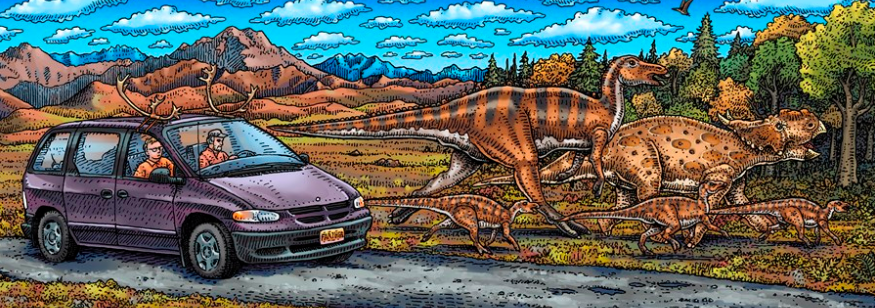
This winter, in the depths of my grieving, in the aftermath of Bendell’s paper and David Wallace Wells’ Uninhabitable Earth, Auggie and I picked up Thunderfeet, a children’s book about Alaska’s dinosaurs. And in reading and rereading it, I found a measure of peace.
Somehow, I managed to make it through my first four decades without really wrapping my head around the fact that dinosaurs once lived on the land that has become Alaska. And certainly I had not considered what the climate might have been like in our prehistoric neighborhood, or given much thought to what other animals or flora had lived here, or how the air felt, how the sun felt on those prehistoric backs. Reading Thunderfeet over and over, with that monotonous zeal that only a toddler can compel, allowed me to let go bit by bit, and relearn the lesson that things will rise and fall over the eons, and that our presence here on this planet in this moment is just a tiny blip. Yes, we are wiping out so many more of the planet’s beautiful species in this horror we have created. But we will go, and something else will rise up, and so it has always been.
The Alaska State Museum just opened a new exhibit on this very topic—dinosaurs and climate change. The Alaska polymath Ray Troll paired up with paleontologist Kirk Johnson and created a wild, imaginative backward look and a clear-eyed, call-it-like-it-is examination of this, the 6th extinction. It’s a beautiful exhibit, and I left feeling like I was breathing fresh air. This year, 2019, seems like the year when we’re all waking up to our climate disaster on planet Earth. But I find it such a relief to finally feel like I’m not alone in my concern. I know many or most people will still march blindly along but, more and more, some of us will no longer be by ourselves. I’ve been thinking of it as realism, but recently I’ve heard Margaret Wheatley refer to it as clarity. I prefer this. To call it realism sounds like an admonishment. Clarity is a personal state, and also an invitation to kinship with others who feel that something is clear.
We’ve brought Auggie into a world that will be starkly enumerated—140 million climate refugees by mid-century, 10 billion people on the planet, 2 or 3 or 5 degrees warming. It is my job now to do what I can—teach him what I can—that he may live through this experience with clarity and his spirit intact. It’s possible his will be the last generation of humans, though it’s not likely. But his world will be incredibly different from mine, and my work as his parent is to give him what he needs to live in it as a whole world. It’s the only world he will know, until the day that he or it gives way to what is next.

 The North Sister